How to Prioritize Your Responsibilities as a Mom
You want to prioritize your responsibilities as a mom, but it’s hard to know what deserves your attention when so many things feel urgent. You may recognize that you’re carrying too much, but aren’t sure what to release, what to change, or what simply needs to be embraced in this season.
There is a way to step back, discern what matters, and approach ordinary life with greater clarity. It’s a way of thinking you can return to as life changes and responsibilities shift.
Family life is full of responsibilities that continually compete for our attention. The needs of young children, homeschooling, getting dinner on the table, laundry, and all the daily tasks that never seem to end. There’s always something that needs to be done, someone who needs something, or something else asking for your attention.
You want to be intentional about how you spend your time and give your attention to the things that matter most. But when so many things feel urgent, it’s easy to spend your days reacting to whatever is right in front of you while trying to keep everything else moving, too. Before long, you may find yourself feeling guilty about the things that haven’t received the attention you wanted to give them, or wondering how you’re supposed to keep up with everything you’re carrying.
The answer isn’t about getting everything done, staying perfectly caught up, or meeting an unrealistic standard for what you should accomplish in a day.
It’s about learning how to step back, look at the responsibilities in front of you, and discern how to approach them. When you have a better understanding of what deserves your attention, what can wait, and how to order your days well, those responsibilities don’t have to feel like they’re constantly pulling you in every direction.
This is something we can learn and practice. A way of approaching ordinary life that we can return to whenever our circumstances change, our responsibilities shift, or when the way we’re doing things no longer seems to be working.
The following five steps offer a place to begin, helping you take an honest look at what you’re carrying and decide how to move forward.
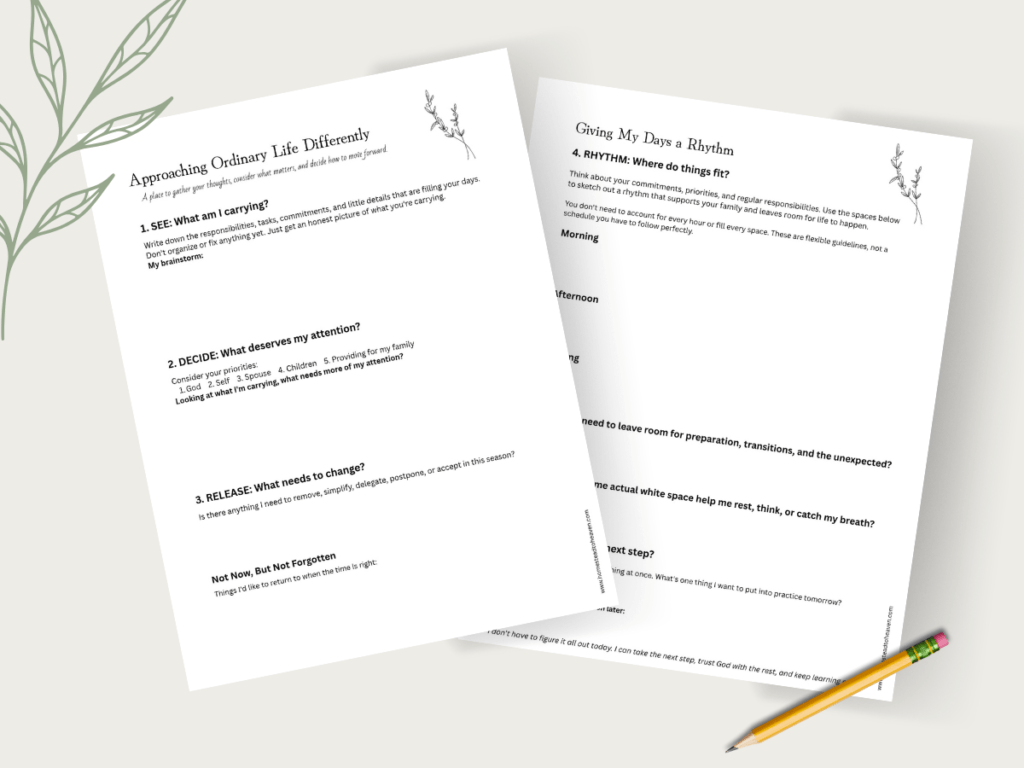
Want a place to work through these steps? I’ve put together a simple printable to help you gather your thoughts, consider your priorities, and sketch out a rhythm for your days. You can download it and work through it as you read.
SEE: What Is Actually Filling Your Days?
Before you can decide what needs your attention or what might need to change, you need an honest picture of what you’re already carrying.

Start by getting everything out of your head and onto paper. Don’t worry about organizing it, prioritizing it, or figuring out how to fit it all in just yet. Just brainstorm.
Especially the first time you do this, try to include more than the obvious responsibilities. Think about the daily tasks, the repetitive needs of your children, meals, laundry, homeschooling, errands, appointments, planning ahead, remembering things, coordinating schedules, and all the little details that fill the spaces between activities.
It’s easy to overlook these things because they’re so familiar. You might not even think of some of them as responsibilities anymore. But they take time, attention, and energy, too.
You may be surprised by how much ends up on your list. And that’s okay. The purpose isn’t to make the list shorter or to fix everything right now. It’s to get a clearer picture of what you’re carrying. Even when there’s a lot, seeing it written out can make it feel more manageable than when it’s all circling around in your head.
I find that no matter how often I do this, I need to come back to it in new seasons. The beginning of this school year was one of those times. There was a lot going on, and I needed to get it all down on paper so I could sort through it, consider my priorities, and figure out how to tackle everything in front of me.
And as we’ll get to in the next step, figuring out how to tackle everything doesn’t mean figuring out how to do it all yourself.
You can return to this brainstorm whenever life changes or your responsibilities shift. Future lists may not need to be quite so detailed, but it’s worth being thorough as you begin.
DECIDE: What Deserves Your Attention?
Now that you have a clearer picture of what you’re carrying, it’s time to consider where your time and attention are going.
It’s easy for the urgent things to take over our days. Meals need to be made, laundry needs to be done, school needs to happen, work needs to get finished, and someone always seems to need something. These responsibilities matter, but they can also crowd out the things we’d really like to make time for.
One way to discern what deserves your attention is to consider your priorities in order:
- God: Your relationship with Him and your prayer life.
- Self: Caring for your physical, spiritual, and personal well-being.
- Spouse: Nurturing your marriage and making time for your husband.
- Children: Being present to and caring for your children.
- Providing for your family: Work, homemaking, homeschooling, service, and the practical responsibilities that support family life.
This hierarchy is based on the Five P’s from Holly Pierlot’s book, A Mother’s Rule of Life. I wrote more about my experience with this approach in A Mother’s Rule of Life.
These priorities aren’t a daily checklist or a measure of how well you’re doing. They’re a way to help you see the bigger picture and consider whether your responsibilities are ordered around what matters most.
Take another look at your brainstorm. Which responsibilities support these priorities? Are there things you’d like to make time for that keep falling to the wayside? Are some of the demands of providing for your family taking up so much room that they’re crowding out something more important?
Not everything on your list will fit neatly into one of these priorities, and not everything that comes later in the hierarchy is unimportant. Your family still needs meals, clean clothes, education, income, and care. Those are real responsibilities. The goal isn’t to neglect them, but to recognize their proper place and give your attention accordingly.
RELEASE: What Doesn’t Belong in This Season?
Once you’ve taken an honest look at what you’re carrying and have considered your priorities, you may begin to see some things that need to change.
Sometimes we need to let go of things that aren’t ours to carry. Just because we care about something or want it to happen doesn’t mean we’re the person who has to make it happen.
Other times, we need to surrender something good. An activity, a commitment, a project, or even an expectation we’ve been holding onto. It may be something worthwhile that simply doesn’t fit in this season of family life.
Letting go doesn’t always mean giving something up forever. Sometimes it means recognizing that something needs to wait. And sometimes it means grieving something you genuinely wanted, even while recognizing that setting it aside is the right decision for now.
As you look at your list, consider whether something needs to be:
- Removed: It doesn’t actually need to be done, or it doesn’t need to be done in this season. If it’s something you’d like to revisit later, add it to a list called Not Now, But Not Forgotten. This gives you a place to keep track of it without continuing to carry it around in your head.
- Simplified: It needs to be done, but perhaps not to the same standard or extent you’ve expected.
- Delegated: Someone else can carry some or all of the responsibility.
- Postponed: It matters, but this isn’t the right time for it.
- Accepted: Some circumstances or limitations can’t be changed right now. Rather than continually fighting against them, you may need to accept them and consider how to move forward within those limitations.
Surrender can be difficult, especially when we’re setting aside something good or meaningful to us. We may have imagined the good fruit that would come from holding onto it, and it can be hard to let go of that expectation.
But sometimes the fruit of surrender is greater than what we thought we’d gain by holding on.
Our part is to be faithful with the responsibilities God has given us. We can make thoughtful decisions, do the work in front of us, and surrender the rest to Him. We don’t have to carry every possibility or make every good thing happen. We can trust God with the outcome.
RHYTHM: Where Do Things Fit in Your Days?
Now that you’ve considered what matters most and what you may need to release, it’s time to think about how the responsibilities you’re keeping fit into your days.
The goal isn’t to create a rigid schedule that every day has to follow perfectly. It’s to establish a rhythm that gives your days some order and consistency without confining you. Life with a family is unpredictable. Needs change, interruptions happen, and some days simply don’t go as planned. A good rhythm gives you something to return to, not another standard to feel guilty about missing.

One way to think about how things fit together is the familiar analogy of golf balls, marbles, and sand.
- Golf balls: These are your fixed commitments and appointments, along with the priorities you’ve decided need protected space in your days. Prayer, time with your spouse, and meaningful time with your children can be golf balls, too, even if they don’t have a specific appointment time.
- Marbles: These are the regular rhythms that support family life: meals, meal preparation, homeschooling, household responsibilities, family time, rest, and recurring activities.
- Sand: These are the smaller tasks, errands, and details that fill in the remaining spaces.
You can approach putting these pieces together in whatever order works best for you. You might start with the commitments already on your calendar, or begin with the priorities you want to make room for. The important thing is to consider both and find a workable way to fit them together.
And don’t forget to leave room for the things that take time around the activities themselves: getting ready, travel, preparation, cleanup, and transitions. These practical margins matter, too.
You may also need some actual white space in your days. Time without another responsibility attached to it. Time to rest, think, process, or simply catch your breath. Some of us need more of this than others, and that’s okay. If you don’t intentionally make room for it, you may find yourself moving from one thing to the next without ever having a chance to regroup.
At the beginning of this school year, our days were full. Homeschooling in the morning, work in the afternoon, and some kind of activity nearly every evening. The logistics of it all worked well on paper, but I started noticing that I was becoming more forgetful and scatterbrained. Things were falling through the cracks, I was more on edge, and I constantly felt like I was missing something.
Over the years, I’ve learned that I need some white space in my days. Time to sit, think, or take care of random little tasks so I can process everything that’s on my plate. Without that breathing room, I start to feel like I’m always trying to catch up, even when everything technically fits into the schedule.
In this case, my husband was the one who recognized that I needed some things taken off my plate and offered to help before I had even gotten around to delegating them myself.
As you think through how your responsibilities fit into your days, you may also recognize places where a more detailed rhythm or plan would be helpful. Maybe you need a chore rotation, a cleaning or laundry schedule, or a meal plan that makes feeding your family easier. You don’t need to stop and create those systems right now. Just make a note of what you’d like to come back to later. You can work through those details one at a time.
Your calendar can help you see the rhythm you’re creating, but it isn’t the goal or the master. Think of it as a visual aid, not a measure of how well you’re managing your life. You’re looking for a rhythm that supports your family and leaves room for life to happen.
You may also find Peaceful Daily Rhythm with Kids helpful as you think about the rhythms that support your family.
ACT: What Will You Put into Practice?
You’ve taken a step back, looked honestly at what you’re carrying, considered your priorities, decided what may need to change, and thought about how to give your responsibilities a place in your days.
Now it’s time to put some of that discernment into practice.
You don’t have to change everything tomorrow. In fact, trying to do too much at once can leave you feeling overwhelmed all over again.
If you’re ready to begin, choose just one thing you’d like to put into practice tomorrow. It might be making time for prayer, simplifying a household responsibility, or giving something you’ve been putting off a little attention.
If you’re ready for a little more, choose two or three changes you’d like to begin working into your days over the coming week.
You may also have made notes about things you’d like to work on later, such as creating a meal rotation or establishing a chore schedule. Those don’t all need to happen now. You can return to them as you’re ready.
Remember, this isn’t about creating a perfect plan or making sure everything goes exactly as you intended. It’s about learning to approach your ordinary responsibilities with greater clarity, making faithful decisions about what deserves your attention, and trusting God with the results.
If prayer is one of the things you’d like to make more room for, you may find Start Your Day with Prayer helpful.
And this isn’t a one-time exercise. As your circumstances change, your children grow, or new responsibilities enter your life, you can return to these steps again. What worked in one season may not work in the next. That’s okay. You can step back, look at where you are, and begin again.
You don’t have to figure it all out today. Just take the next step, and give yourself permission to keep learning as you go.
Our circumstances will change. Our responsibilities will shift. There will be seasons when we need to step back and reconsider how we’re approaching things. That’s not a sign that we’ve failed or that we need to start over from scratch. It’s simply part of living faithfully in the life God has given us.
We do our part, trust Him with the rest, and keep going.